For a long time, I thought being productive meant filling every hour. If my calendar was packed and my to-do list was long, I assumed I was doing well. Then I’d hit 4pm completely drained, having accomplished almost nothing that actually mattered, while somehow still feeling busy the entire day.
What changed things for me wasn’t a new app or a stricter schedule. It was realizing that productivity isn’t really about effort or hours. It’s about matching the right kind of task to the right moment and most of us have never been taught to think that way.
What productivity actually means
It’s worth pausing on the definition, because “be more productive” gets thrown around as if it just means “go faster.”
Productivity is better understood as the intersection of three things: how much time a task takes, how difficult it actually is, and how effectively you complete it. A task that takes you three hours isn’t a productivity failure if it’s genuinely a three-hour task. The most productive person in the world still won’t rush through something and expecting yourself to is a fast way to feel like you’re failing at something that was never realistic to begin with.
What actually moves the needle is less about willpower and more about three things you can influence directly: your environment, your energy, and when you choose to do what.
Your body has its own schedule work with it
Dr. Michael Breus, a clinical psychologist specializing in sleep, popularized a simple but useful idea: instead of asking “how do I become more productive,” ask “when am I naturally at my best?” Everyone has a biological rhythm, and most of us are trying to force a one-size-fits-all 9-to-5 onto a body that doesn’t actually run on that schedule.
Breus groups people into four rough chronotypes. They’re caricatures, not boxes most people are a blend but naming the pattern you lean toward is genuinely useful:
- Bear (about half of people): follows the sun, sleeps 8+ hours, adapts reasonably well to a standard schedule but often feels like they’re “always working.”
- Lion: wakes early, sharp and energetic in the morning, fades by evening. Associated with drive and early starts.
- Wolf: slow to start, foggy in the morning, comes alive in the late afternoon and evening. Often the more creative, introverted profile.
- Dolphin: light sleeper, needs the least sleep, sharp early but tends to dip in the afternoon. Prone to overthinking and perfectionism.
None of this is destiny. But if you’ve spent years scheduling your hardest work for 9am and wondering why it never sticks, and you suspect you’re actually a Wolf that mismatch might be the real problem, not your discipline.
The three zones in every day
Whatever your chronotype, your day tends to break into three kinds of windows:
- Deep-focus zone: when you’re sharpest. This is where your hardest, most important work belongs.
- Creative zone: good energy, but better suited to brainstorming, writing, or content creation than to your most demanding analytical work.
- Low-key zone: decent but not peak. This is the right time for email, admin, and scheduling calls not your hardest problem of the day.
Here’s roughly how those zones tend to fall across each chronotype:
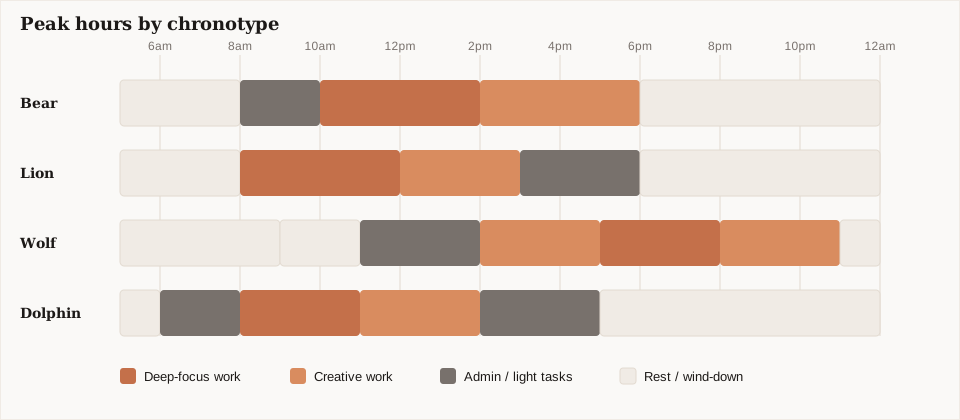
The pattern that jumps out: a Lion doing their best work at 9am and a Wolf doing their best work at 7pm aren’t different in discipline they’re just running different internal clocks. If you manage a team, this is worth remembering before you assume someone who’s slow to start in the morning is simply less committed.
Tactics worth trying
None of these require reinventing your whole routine. Pick what’s useful, skip the rest.
Cap your top priorities at three. A long to-do list feels productive but usually just creates anxiety. Three real priorities a day, chosen deliberately, beats fifteen items you’ll never finish.
Stop multitasking. What feels like doing two things at once is actually your brain rapidly switching between them and each switch costs you focus. You end up slower on both tasks, not faster.
Do the hard thing first. Brian Tracy’s old advice from Eat That Frog still holds up: tackle your most unpleasant or difficult task before anything else. Everything after it feels easier by comparison.
Plan tomorrow today. Ten minutes at the end of the day deciding what tomorrow looks like removes the “what should I even start with” tax the next morning and your brain will often keep chewing on it overnight.
Protect your inbox. Checking email two or three times a day, at set times, beats leaving it open as a constant interruption. If clients need to know, say so a line in your signature explaining your response window sets the expectation for you.
Use the two-minute rule. From David Allen’s Getting Things Done: if something takes less than two minutes, do it immediately instead of letting it pile up as mental clutter.
Don’t chase perfect. If a task is at 90% in two hours, the remaining 10% often isn’t worth another two hours. Know which tasks actually deserve that extra polish and which don’t.
Take real breaks. A short break every 90 minutes or so isn’t lost time it’s what keeps your output from degrading over the following hour.
Learn to say no. Every yes to something outside your priorities is a yes to less time for what actually matters. Protecting your schedule is part of the job, not a luxury.
Five methods that hold up
Pomodoro: work in focused 25-minute blocks with 5-minute breaks, and a longer break every couple of hours. Especially useful for tasks you keep avoiding.
Batching: group similar tasks together instead of scattering them through your day. Write all your content in one sitting, answer all your emails in another. Constant context-switching between different types of work is its own tax.
Deep Work: a term popularized by Cal Newport: schedule your hardest, most cognitively demanding work during your actual peak hours, protected from interruption. This is where knowing your chronotype pays off directly.
The Pareto principle: roughly 20% of your efforts produce 80% of your results. Periodically ask where your revenue, traffic, or impact is actually coming from, and be honest about which of your daily tasks fall in the remaining 80% that isn’t moving anything.
Time blocking: instead of a loose to-do list, assign specific tasks to specific slots on your calendar. It forces realistic estimates and tends to reveal how much of a normal day gets eaten by things you didn’t actually plan for.
Productivity isn’t a competition
None of this is about becoming a machine. The point of being productive isn’t to cram in more it’s to free up time and mental space for the things that actually matter to you, whatever those are.
If you take one thing from this: stop asking yourself “why can’t I just push through,” and start asking “when is this task actually going to go well for me.” That single shift in framing does more than most productivity systems combined.